
If you work in sustainability-led construction, procurement or life cycle assessment (LCA), you need to know what a +A2 EPD is and how it differs from the +A1 format it replaces. Environmental Product Declarations (EPDs) have become the common language for the environmental performance of building products. They give transparent, standardised data for carbon reduction strategies, procurement decisions and regulatory submissions, and since EN 15804+A2:2019 the rules for producing them have changed.
The newer EPDs are more detailed, more transparent and more closely aligned with European climate policy. They also bring new technical requirements and some traps for designers, contractors and sustainability consultants. Our Knowledge Share covers the assessments that use this data; here we set out what a +A2 EPD is, how it differs from the older +A1 format, and what to check before you rely on one.
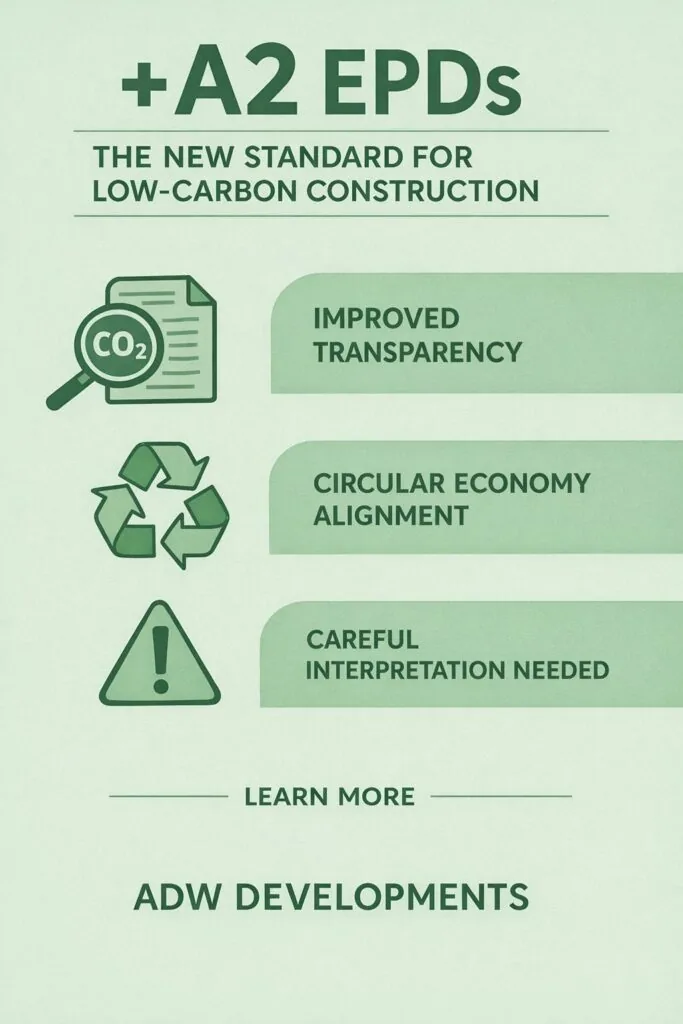
What a +A2 EPD is
A +A2 EPD is an Environmental Product Declaration that complies with EN 15804+A2:2019, the updated European standard for life cycle-based environmental impact reporting. One point catches people out. Many of these newer EPDs cover only Modules A1 and A2 of the life cycle, raw material supply and transport to the manufacturer, and not the full product stage (A1–A3). Such an EPD is partially scoped: it complies with EN 15804+A2, but it may not give a complete picture for a whole life carbon assessment.
What the A2 amendment changed
The A2 amendment was introduced to align EPDs with the European Commission's Product Environmental Footprint (PEF) method, to support circular economy metrics and to improve digital transparency. The main changes are 13 core impact categories in place of the 7 under A1; separate reporting of fossil, biogenic and land use change carbon emissions; mandatory reporting of the end-of-life modules C1–C4 and of Module D (recovery and reuse); and structured data formats compatible with ILCD (XML) systems.
If you are working on BREEAM, a London Plan Circular Economy Statement or whole life carbon optioneering, the A2 version is the current technical baseline.
+A2 against +A1
| Feature | EN 15804+A1 | EN 15804+A2 |
|---|---|---|
| Global warming potential (GWP) | Single value | Four values: fossil, biogenic, land use and total |
| Impact categories | 7 core | 13 core plus 6 optional |
| End-of-life data (C modules) | Optional | Mandatory |
| Module D (recovery benefits) | Optional | Mandatory |
| Circularity metrics | Minimal | Extensive |
| Digital format | PDF or bespoke | XML-ready (ILCD format) |
| Comparability | Easier | Needs caution and expertise |
The two formats cannot be compared directly. The impact categories, the methods and the data models differ, and setting an A1 figure next to an A2 figure without adjustment gives an invalid result. To tell them apart, look for the declaration on the document, "in accordance with EN 15804+A2:2019" or "EN 15804+A1:2013", and check which modules are reported. A1 covers raw material extraction and A2 covers transport to the factory; Module D estimates the potential benefit from reuse, recycling or recovery beyond the building's life cycle, and it is mandatory in a +A2 EPD.
What it means for LCA, whole life carbon and BREEAM submissions
If your EPD data is out of date or incomplete you can fail to meet minimum evidence thresholds, introduce errors into a carbon optioneering model, have a Circular Economy Statement rejected by the GLA, or misrepresent product performance in a whole life costing (WLC) study. Most carbon modelling tools, One Click LCA and eTool among them, now ask whether an EPD follows A1 or A2, because the distinction affects credit calculations, comparability and transparency.
A +A2 EPD can be used for BREEAM or an LCA, but check first whether it includes A3, C1–C4 and D, because some BREEAM tools require full product-stage data. The common pitfalls are:
- Treating a partial EPD (A1–A2) as complete product-stage data.
- Comparing +A2 results directly with +A1 results.
- Misreading GWP-biogenic or Module D figures.
- Submitting a partial declaration as evidence for BREEAM Mat 01 or an LCA.
- Not validating the data sources and assumptions behind the declaration.
How we bridge A1 and A2
At ADW Developments we provide life cycle assessments using both A1- and A2-compliant EPDs, whole life carbon assessments aligned with RICS and GLA guidance, Circular Economy Statements grounded in the correct material scope, reconciliation of data across legacy and current EPD formats, and evidence that stands up for BREEAM, planning and net zero reporting. We work with legacy EPDs and with +A2 declarations, interpret the data correctly, reconcile the missing modules, and build models that meet what the regulator and the client expect, so the documentation is accurate, auditable and aligned with EN 15804. We have done this for clients across commercial, industrial and public sector developments, covering carbon data, procurement strategy and regulatory submissions.
If you have a set of EPDs in mixed formats to reconcile, email enquiries@adwdevelopments.com, call +44 (0)20 3239 2394, or use the contact form.