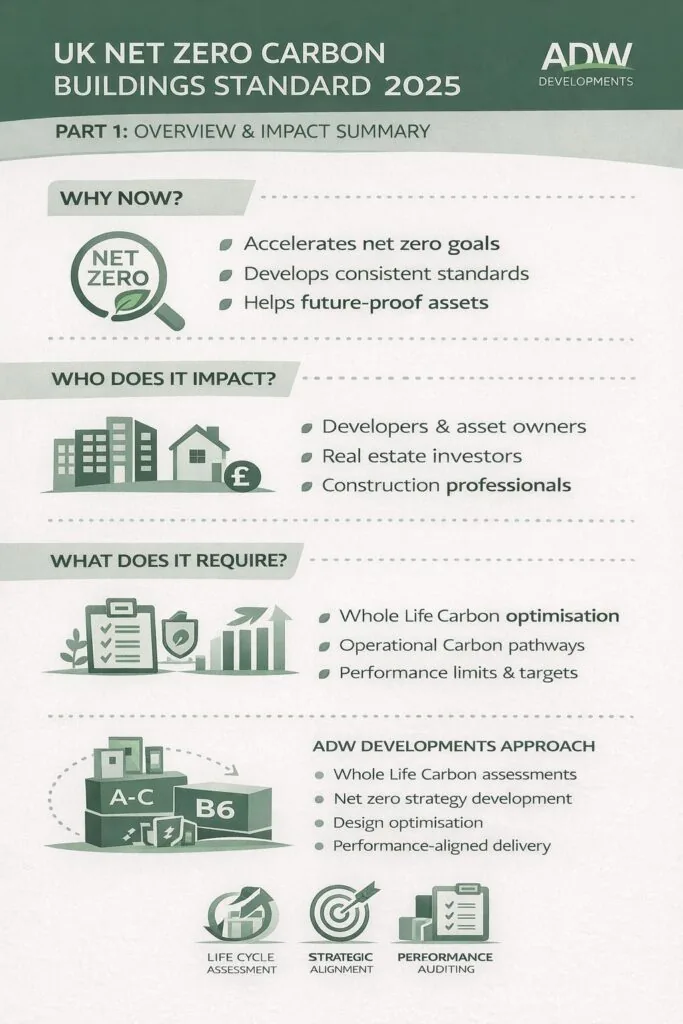
The UK Net Zero Carbon Buildings Standard (NZCBS) gives the UK a single, industry-backed definition of what 'net zero carbon' means for a building. This is part 1 of our guide to it: what the Standard is, which buildings it covers and how its requirements differ between new buildings, existing buildings and data centres. Understanding it early lets a building owner, developer or sustainability lead make decisions that protect asset value, reduce risk and line up with where regulation and the market are heading.
The subject is a broad one, so we will cover it in several parts over the coming weeks. The series translates the Standard into actions at the level of an individual asset.
Where the Standard comes from
The built environment is responsible for around 40% of the UK's carbon emissions, which makes buildings one of the largest and most immediate opportunities to cut carbon. Until the Standard arrived there was no agreed definition of a net zero building, and the guidance was fragmented and often inconsistent.
The NZCBS fills that gap. A coalition of professional bodies, industry groups and sustainability experts developed it. The Pilot Version was published in September 2024 and the latest revision in April 2025, so it represents the current thinking on net zero buildings in the UK. It replaces the fragmented guidance with one framework, and that brings consistency, credibility and measurable performance expectations across the sector.
Whether you are developing new projects, managing existing stock or advising clients, the Standard will shape design decisions, investment strategy and the long-term performance of your assets. Aligning with it early is an advantage as the industry moves to performance-based net zero delivery.
What the Standard defines
The NZCBS is an industry-wide framework that defines what it means for a building in the UK to be 'Net Zero Carbon Aligned'. Because professional institutions, industry groups and sustainability experts wrote it jointly, it gives the sector one benchmark against which building performance can be compared, reported and verified.
Three things the Standard does
- It defines what "net zero carbon" means for each building type.
- It sets science-based performance targets that align with the UK's carbon budgets.
- It establishes a verification method based on measured performance in use.
The third of these is what makes the Standard effective. Vague claims and greenwashing do not pass: a building has to demonstrate its net zero status with measured data from at least 12 months of operation.
The 13 building types it covers
The Standard applies across most of the built environment, so it is relevant to most property professionals. The building types are:
- Commercial residential
- Culture and entertainment
- Data centres
- Healthcare
- Higher education
- Homes
- Hotels
- Offices
- Retail
- Schools
- Science and technology
- Sport and leisure
- Storage and distribution
New buildings, existing buildings and data centres
The requirements differ by category, and this is where the Standard starts to bear on design.
| Category | What the Standard requires |
|---|---|
| New buildings | Absolute limits on delivered space heating and cooling (annual kWh/m² and peak W/m²), total operational energy demand and on-site renewable generation. |
| Existing buildings | Report performance metrics. No mandatory operational limits yet. Any major retrofit will need to meet the 2040 targets. |
| Data centres | Report all metrics. Exempt from the heating and cooling limits for now. |
For a new building the limits shape the design strategy, the choice of systems and how the building performs for the rest of its life. For an existing portfolio the lighter touch sets a clear trajectory: report now, and improve towards the 2040 targets. Data centres are treated separately because of their operating characteristics and their high energy intensity.
What part 2 covers
The next post in the series covers which emissions the NZCBS tracks, the embodied carbon benchmarks and the numbers behind them, and the requirements a building owner has to meet. Each one comes with the steps to take on your own assets.