A durable building keeps performing under the conditions it was designed for, and a resilient one survives the conditions it was not. Buildings now need both, because climate extremes, pressure on resources and changing user needs are arriving together, and the materials, the design and the systems you choose decide how much whole life carbon the building emits and how much of its value it keeps. Below we define the two terms, set out why they matter more than they did, and list six strategies for building them in; the Knowledge Share has more on each.
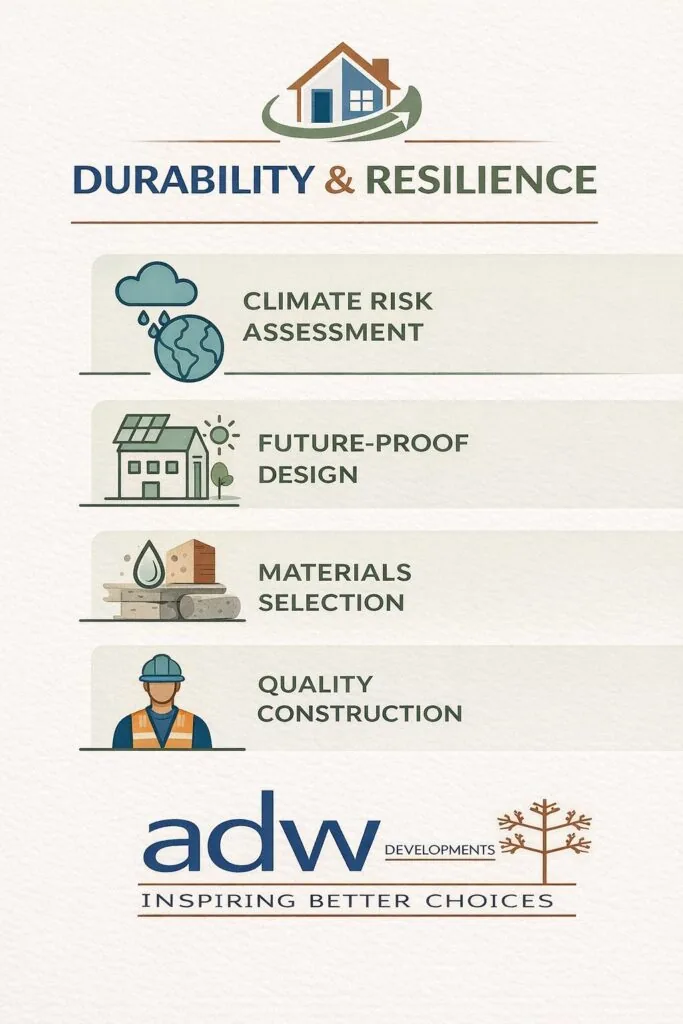
What the two words mean
The terms are often used interchangeably, but they describe different qualities and a building needs both. Durability is the ability of a building or its components to maintain performance over a specified period, under the environmental and operational conditions expected, without unforeseen maintenance or repair. It is about longevity and resistance to degradation: wear and tear, chemical attack, weather extremes and the other ways materials deteriorate. In practice durability comes from four things: materials chosen to resist decay, corrosion and fatigue (high-quality concrete, treated timber, corrosion-resistant metals); correct detailing, installation and workmanship, so nothing fails early; an inspection and maintenance programme that finds problems while they are small; and service life planning, so each component is designed with a clear view of its expected lifespan and replacement cycle.
Resilience is the capacity of a building, a community or a system to prepare for, withstand, respond to and recover from a disruptive event: a natural disaster such as an earthquake, flood, storm or wildfire; a climate change impact such as a heatwave or sea-level rise; or a technological, economic or social shock. Where durability is about lasting, resilience is about adapting and recovering. It has five parts.
| Part | What it means for the building |
|---|---|
| Resistance | Absorbing the impact of a disruptive event without significant damage or loss of function |
| Redundancy | Back-up systems or alternatives that keep the essential functions running |
| Resourcefulness | Adapting and improvising in response to a challenge nobody planned for |
| Recovery | Restoring function quickly and efficiently after the disruption |
| Adaptability | Adjusting to conditions that change over time, particularly as climate impacts intensify |
Durability lets a building last under normal conditions; resilience lets it survive and recover from abnormal ones.
Why both matter more than they did
Extreme weather is more frequent, the long-term effects of climate change are arriving, resources are constrained and users expect more of their buildings. Each of those pressures has a cost that durability and resilience reduce.
Climate adaptation
Buildings have to be ready for higher temperatures, more intense rainfall, flooding and stronger winds. Durable materials and resilient design, from flood-resistant foundations to strong building envelopes, keep the building functioning during and after such events and reduce the disruption that follows.
Resource scarcity and the circular economy
A durable building consumes fewer resources over its life because it needs repair and replacement less often. That lowers the demand for raw materials and the waste produced, and it aligns with circular economy principles. Durability is an economic advantage and an environmental necessity at the same time.
Whole life carbon
Extending a building's lifespan spreads its embodied carbon over more years and lowers its annual carbon intensity. Resilient design also avoids the carbon-intensive repairs and the early demolition that follow a failure. The whole life carbon saving from the two together is significant.
The cost of failure
A building that fails through poor durability or a lack of resilience imposes heavy costs: repair bills, business disruption, displaced communities and, at worst, risk to life. Resilient infrastructure protects the investment, lowers insurance costs and keeps people safe.
Changing use and technology
Buildings have to keep pace with new technologies, regulatory change and rising user expectations. Resilient design usually includes adaptability, so the building can be reconfigured and upgraded without major intervention and stays useful and valuable for longer.
Six strategies for building them in
Durability and resilience have to be designed in from the first stage and carried through construction and operation, and they need collaboration across disciplines and the supply chain to hold up over the long term. Six strategies do most of the work.
1. An integrated design process
Bring the architects, engineers, material scientists, climate specialists and cost consultants together from the outset, so that durability and resilience are objectives of the design and the solutions answer several criteria at once. Run a thorough risk assessment and scenario planning to identify the hazards the site faces, whether flooding, seismic activity or extreme weather, and design for them from the start. And think across the life cycle: performance, environmental impact and maintenance over the building's lifespan, not initial cost alone.
2. Material selection and specification
Choose materials proven to withstand the stresses they will meet, such as corrosion or structural fatigue, and suited to the conditions expected now and in future, including extreme temperatures and high humidity. Prioritise low-impact, recyclable content, which supports circularity. Design components that can be replaced, repaired or reconfigured; that improves durability and allows a quick response to damage or to a change in need.
3. Structure and envelope
Build in structural redundancy, so the failure of one component does not compromise the whole. Design the foundations to resist flooding, ground movement and seismic events. Manage water with waterproofing, efficient drainage and elevated systems that keep it out. Control heat transfer and moisture to prevent condensation, mould and material degradation.
4. Passive design
Natural ventilation and daylighting reduce reliance on mechanical systems, lower carbon emissions and keep the building usable during a power outage. High thermal mass regulates internal temperature and cuts heating and cooling demand. Shading and well-specified glazing control solar gain and glare, for comfort and for energy efficiency.
5. Monitoring and smart technology
Sensor networks that track temperature, humidity, air quality and energy use detect problems early. A digital twin simulates the building's performance, predicts failures and lets operations be tuned continuously. Predictive maintenance uses that data to plan work before a breakdown, which extends the life of the asset.
6. Post-occupancy evaluation
Post-occupancy evaluation (POE) measures how the building actually performs and identifies what to improve, which gives the next project a feedback loop to learn from. Adaptive management then adjusts operations and maintenance in response to the performance data, so the building stays fit for purpose.
Applied together, the six take a building beyond the minimum standard, to one that will last and recover through the rest of this century. To discuss how durability and resilience fit into your project, contact ADW Developments.