Material adaptability is the ability of a building's materials and systems to be reconfigured, repurposed or relocated, so that the building can change with its users instead of becoming obsolete. Rapid technological change, shifting social priorities and the growing impacts of climate change all put the same question to a project team: how do we build something that meets today's needs and stays relevant in the future? Durable, low-carbon materials answer part of that question; adaptability answers the rest.
Adaptable design extends the useful life of resources and cuts waste. Below we set out what material adaptability means against durability and flexibility, the five reasons it is being asked for, and the five strategies that deliver it: design for disassembly, material choice, modular construction, material passports and flexible layouts.
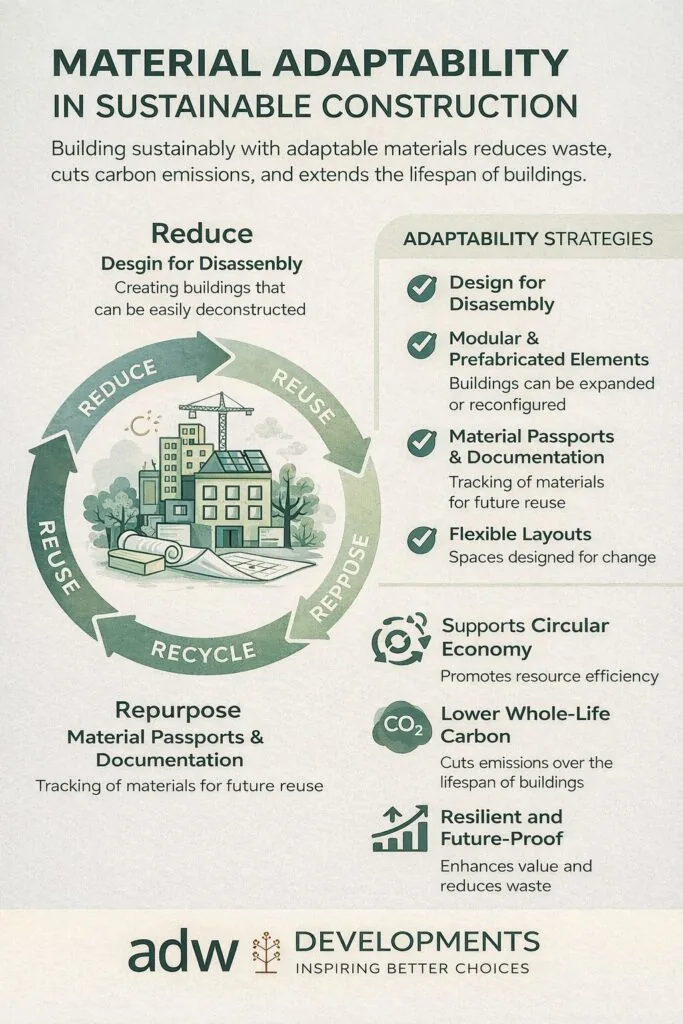
Adaptability against durability and flexibility
The three terms are related and often confused. Durability is a material's or component's ability to keep performing over time under the conditions it was designed for: resistance to degradation, and keeping its original form and function. Flexibility is a property of the design, not the material: how easily spaces or systems can be altered for different uses or layouts, through movable partitions, modular furniture or accessible service routes.
Material adaptability goes further than either. It describes the characteristics of materials and components that allow them to be reconfigured (changed in form or arrangement for a new purpose within the same building), repurposed (applied to a completely different function, in the same building or elsewhere), disassembled and reassembled (taken apart without damage and put back together in another configuration or location), or recycled at high value when direct reuse or repurposing is not possible, because the material has kept its quality.
In practice it means choosing and designing materials for their future lives as well as their first use, and planning for recovery, processing and reintegration into new cycles. Waste falls, the value in the material is kept, and circularity becomes possible.
Five reasons it is being asked for
1. The circular economy
The linear take, make, dispose model of construction is unsustainable. Material adaptability is what underpins a circular economy: it keeps resources in use for longer, and designing for disassembly and reuse reduces the demand for virgin resources, cuts landfill waste and closes material loops. The industry shifts from consumption towards regeneration.
2. Whole life carbon
Embodied carbon from extraction, manufacturing and transport is a major part of a building's whole life carbon (WLC) footprint. Reuse, adaptation and high-value recycling cut the need for new, carbon-intensive production. The carbon already invested in a component goes on working for longer, its impact is spread over more years, and WLC reduction targets become easier to meet.
3. Resilience
A building made with adaptable materials can respond to change, whether that is a change of use, a new technology or a climate impact. Adaptable partitions, for example, allow an office layout to become residential units without major demolition. The asset stays resilient and relevant for decades longer.
4. Cost and value
Adaptable design can cost more at the outset. Over the life of the building it returns that cost through lower waste disposal charges, income from recovered materials sold on, cheaper renovations because the components were designed to be changed, higher asset value from long-term versatility, and new business in adaptable materials and deconstruction services.
5. Regulation
Governments increasingly support material efficiency and circularity through material passports, design-for-disassembly requirements and waste reduction targets. A project that adopts adaptability now will meet future regulation with less effort and show leadership in sustainable construction in the meantime.
Five strategies that deliver it
Material adaptability comes from combining design principles, material choices and construction methods. There are five main strategies.
1. Design for disassembly
Design for disassembly (DfD) makes deconstruction safe and efficient and avoids destructive demolition. It relies on reversible connections, bolts, screws and clamps rather than adhesives or welds; on standardised, modular components that can be reused or interchanged; on accessible routes for services such as plumbing, electrics and HVAC; on clear documentation of the materials, connections and methods; and on layered design, so that elements with different lifespans can be replaced independently.
2. Choice of materials
The materials themselves have to support adaptability. That means durable, high-quality materials that keep their value and integrity over several uses; recycled or reused content that reduces demand for virgin resources; non-toxic materials that are safe to reuse and healthy to live with; and materials suited to several applications, such as timber, steel and precast concrete.
3. Modular and prefabricated construction
Off-site manufacture supports adaptability directly. Modules are easy to assemble, disassemble and relocate. Factory production gives higher quality and precision, reduces on-site waste and improves material management, and the build is faster, so the building can answer a market need sooner.
4. Material passports
A material passport records detailed data about a building's materials: their origin, composition and reuse potential. With that record the resources are traceable, the valuable materials can be identified, future renovation or deconstruction can be planned on fact, and the building can take part in circular economy marketplaces.
5. Flexible and universal design
Designing flexibility in from the start avoids costly interventions later. Open floor plans allow layouts to change. Raised floors and accessible ceilings allow the services to change. Oversized service ducts leave room for future expansion. Universal design keeps the building usable by everyone, for the long term.
Together these strategies let the industry treat a building as a material bank, not a disposable asset. More on the circular economy and whole life carbon is in our Knowledge Share.