A component-level life cycle cost appraisal is worth one credit under Man 02. It has to be completed by the end of RIBA Stage 4. By that point, most project teams believe the specification decisions are behind them. That belief is what costs the credit.
The elemental analysis at Stage 2 gets most of the attention, and rightly so. It carries two credits, and it shapes the scheme. The component work at Stage 4 is smaller, later and easier to miss. Teams often arrive at it with the options already closed.
What the component level life cycle cost plan covers
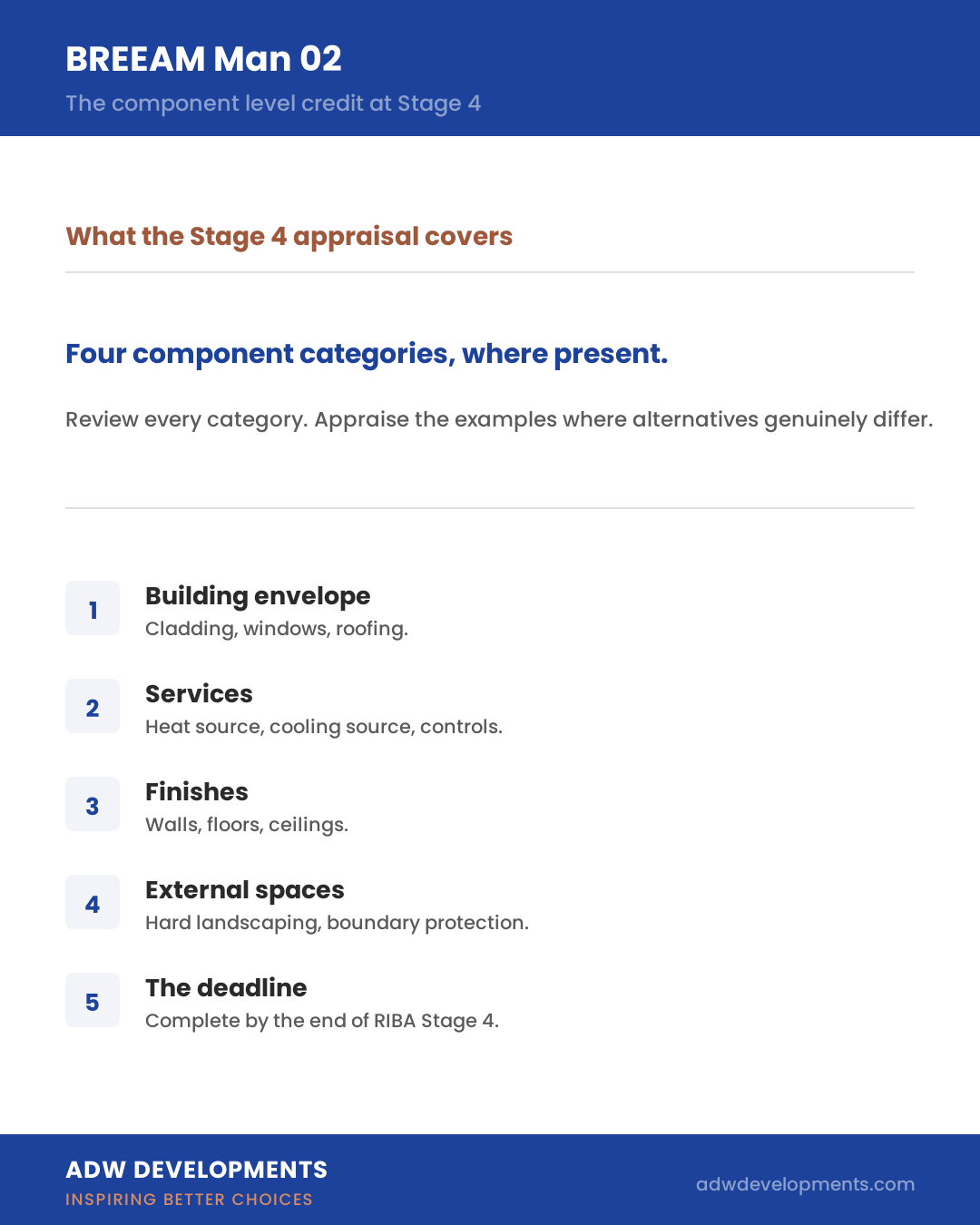
The appraisal addresses four categories of component, where they are present in the scheme.
The building envelope, covering items such as cladding, windows and roofing. The services, covering items such as the heat source, the cooling source, and the controls. The finishes, covering walls, floors and ceilings. The external spaces, covering items such as hard landscaping and boundary protection. The team reviews each category.

Component level and elemental are different exercises
Teams frequently treat these two parts of Man 02 as one piece of work carried out twice. They are not.
The elemental analysis at Stage 2 compares design options at the level of the building element and the scheme strategy. Which structural approach. Which servicing strategy. Which envelope type. It runs while those questions remain genuinely open, and it informs the answer.
A component level life cycle cost appraisal compares specifications within an element whose strategy is already settled. The envelope type belongs to concept stage. The appraisal asks which cladding system, which glazing specification, which roofing build-up.
The distinction matters because the two produce different conversations. A team that repeats its Stage 2 analysis in more detail at Stage 4 has not done what the credit asks.
How much to appraise
The team reviews every component category. It does not have to appraise every example within one.
The requirement is a selection likely to produce useful comparisons. A cladding system with two viable alternatives at meaningfully different capital and maintenance costs is worth appraising. A standard internal door specification with no realistic alternative is not.
This is where judgement enters. An appraisal covering a long list of components that differ in no meaningful way consumes fee and produces nothing. An appraisal that covers four or five components where the alternatives genuinely diverge gives the design team something to act on.
Why Stage 4 is the deadline for component-level life cycle cost
Man 02 is an options appraisal credit at both stages, and an options appraisal only works while options exist.
Stage 4 is technical design. Specifications are firming up, and the procurement route is taking shape. The window is still open, but it is closing. A team that starts the component work during Stage 4 can still influence what gets specified. A team that starts it afterwards is documenting decisions rather than informing them.
BREEAM asks for evidence that the analysis shaped the design and specification. Analysis produced after the specification is frozen cannot demonstrate that, whatever its technical quality.
What the appraisal has to demonstrate
The analysis follows ISO 15686-5, as the elemental work does.
It compares alternative specifications for each component selected. It identifies the option with the lowest life cycle cost across the agreed period of analysis. It supports the comparison with measures the design team and the client can use, such as payback period and return on investment.
The output is a record of decisions taken on the evidence, not a spreadsheet produced alongside them. The design team has to show how the component level life cycle cost work changed the specification. Confirming a choice already under consideration also counts.
Where it sits in the rest of Man 02
Man 02 carries four credits under BREEAM UK New Construction 2018, awarded in three independent sections.
Two credits for the elemental life cycle cost plan at the end of RIBA Stage 2. One credit for the component level appraisal at the end of RIBA Stage 4. One credit for capital cost reporting, submitted in pounds per square metre of gross internal floor area.
Independent award matters here. A project that misses the Stage 2 deadline has not lost the component credit. A project that never commissions a component level life cycle cost appraisal can still take the other three. Teams sometimes abandon the whole credit after missing the first deadline. On a scheme close to a rating threshold, that is an expensive assumption.
Service life assumptions carry across both stages. Replacement intervals for a cladding system at Stage 4 should match the assumptions behind the envelope at Stage 2. Record both. Service life planning is the second half of Man 02, and it is the part most often left implicit.
Planning the stage 4 work
Commission the component work during Stage 3. The appraisal has to finish by the end of Stage 4, which means the analysis has to begin while the specification is still in draft. A team that waits for Stage 4 to open has already lost most of the window.
Agree which components the appraisal will cover, and record the reasoning. A short note explaining that four components made the list because their alternatives diverged, and that others did not, carries more weight with an assessor than an appraisal covering everything at a shallow depth.
Keep the period of analysis and the service life assumptions consistent with the Stage 2 work. Two analyses of the same building built on different assumptions produce results that cannot be read together, and an assessor will ask why.
Handled this way, the component level life cycle cost appraisal informs the specification rather than recording it. That is what the credit asks for, and it is where the value to the client sits.
ADW Developments provides Man 02 life cycle cost and service life planning for BREEAM assessments. If you have targeted Man 02 to obtain your BREEAM credits, get in touch enquiries@adwdevelopments.com.